
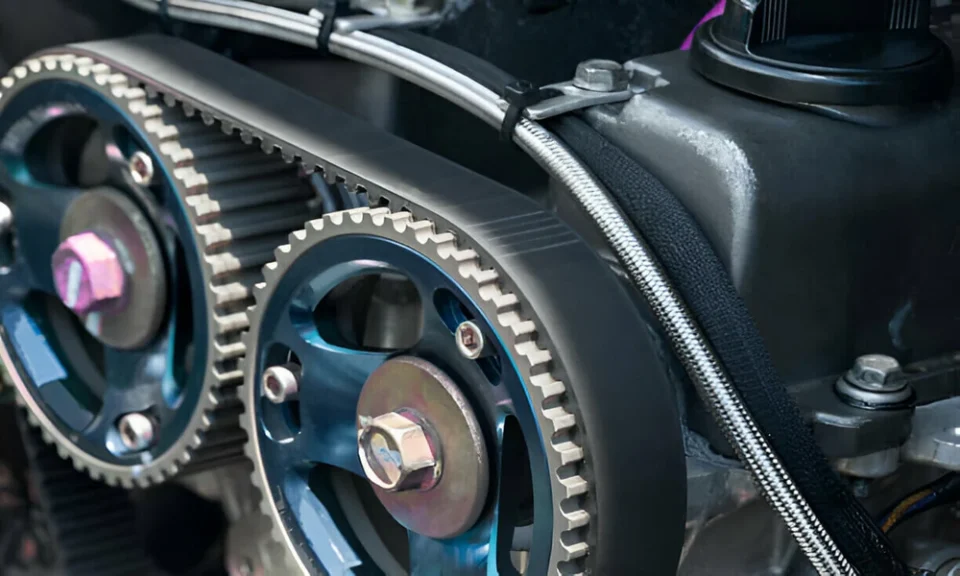
The timing belt is one of the most mechanically precise components in any synchronous drive system – its entire functional value rests on the dimensional accuracy of its tooth profile and the consistency of its material properties across the operating life. Choosing a timing belt manufacturer in India on price alone, without evaluating the quality standards and manufacturing processes behind the product, is a false economy that typically reveals itself in reduced service life, premature drive failure, or the production downtime that a mid-cycle belt replacement causes. Understanding what quality actually means in industrial timing belts manufacturing helps procurement engineers and maintenance teams make a supplier selection that holds up across the full operating life of the drive.
Why Dimensional Accuracy Determines Timing Belt Performance
A rubber timing belt achieves its synchronous drive function through the precise meshing of its tooth profile with corresponding grooves on the toothed pulleys. This meshing must be geometrically accurate to ISO or DIN standard tolerances if the belt is to transmit motion without backlash, without tooth ratcheting, and without the vibration that dimensional inaccuracy introduces into high-speed or precision drives.
Quality timing belt manufacturers in India produce belts whose tooth profiles are moulded and cured with the tooling precision and process control that dimensional accuracy requires. Belts from manufacturers with inadequate tooling or inconsistent vulcanisation processes produce tooth profiles that vary across the belt’s length or between production batches, creating the kind of geometric inconsistency that degrades drive performance in ways that are difficult to diagnose without detailed belt inspection.
Compound Quality and Its Effect on Service Life
The rubber compound used in industrial timing belts determines the belt’s resistance to the three primary failure mechanisms that limit timing belt service life: fatigue cracking from repeated flexing around pulleys, hardening and loss of elasticity from heat exposure in high-temperature operating environments, and swelling or softening from contact with lubricants or chemicals in the drive environment.
Premium timing belt compounds incorporate specific polymers, reinforcing agents, and stabilisers that resist these failure mechanisms across the operating conditions the drive encounters. Economy compounds produced to minimise material cost sacrifice one or more of these resistance properties, producing belts that perform adequately in ideal test conditions but deteriorate prematurely in real industrial operating environments. The difference between a premium and an economy compound is rarely visible during incoming inspection – it emerges in service life data over months of operation.
Tensile Member Quality and Load Capacity
The tensile member – the fibre cords running longitudinally through the belt’s body – carries the mechanical load that the timing belt transmits. In quality rubber timing belt manufacturing, the tensile member uses high-modulus fibres such as fibreglass, aramid, or carbon laid in precise, consistent tension during manufacturing, ensuring that load is distributed uniformly across the full belt width and that the belt maintains its pitch length under operating load.
Tensile members using lower-quality fibres or inconsistently tensioned during manufacturing produce belts whose pitch length changes under load – introducing the positional error that precision drive applications cannot tolerate – or whose load capacity deteriorates through tensile member fatigue before the belt’s tooth or compound system shows external signs of failure.
Why Supplier Consistency Matters as Much as Initial QualityEven a timing belt manufacturer producing high-quality product in a first order can represent a supply risk if their quality management systems do not ensure batch-to-batch consistency. Industrial drives designed and set up around belts from one production batch will experience performance variation if subsequent batches carry dimensional or compound differences that fall within the manufacturer’s stated specification but at the boundaries of that specification rather than at the nominal values.
Rubber drive belts suppliers with ISO 9001-certified quality management systems and documented statistical process control on their key manufacturing parameters provide the batch consistency evidence that allows procurement teams to specify a supplier with confidence that subsequent deliveries will match the performance of the original qualification sample.
Conclusion
The quality of a timing belt manufacturer shapes not just the initial performance of a synchronous drive but its reliability and maintenance burden across the full operational life of the installation. Dimensional accuracy, compound formulation, tensile member quality, and manufacturing consistency are the four dimensions that distinguish industrial timing belts from quality suppliers from those that meet the minimum specification on paper but underperform in practice. These considerations are equally important when evaluating industrial belt manufacturers india, as manufacturing precision, material quality, and process consistency directly influence drive efficiency, equipment uptime, maintenance intervals, and the overall total cost of ownership. Procurement decisions based on a thorough evaluation of these quality dimensions consistently produce lower total cost of ownership than those based on unit price alone.
