
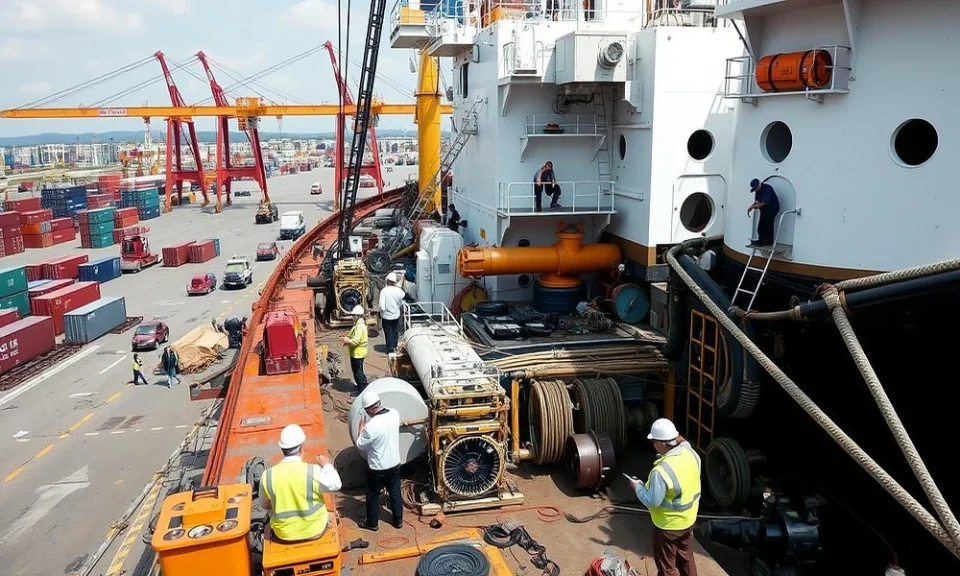
A misjudged ship hold can turn a profitable charter into a costly dispute. For owners and charterers alike, assessing ship hold conditions before and after chartering is a critical safeguard, one that often determines who pays for unexpected repairs and lost cargo claims.
Understanding Ship Hold Condition Surveys
Ship hold condition surveys go far beyond a simple walkthrough. Their primary task is to provide an unbiased record of the vessel’s condition at the precise moments of on-hire (start of charter) and off-hire (end of charter). The survey’s scope includes everything from the holds themselves to the main deck, cargo working spaces, and even the vessel’s external shell plating.
Purpose and Importance in Chartering
Why are these surveys so important? At their core, they ensure each party, owner or charterer, is protected against damages unfairly attributed to them. By documenting the exact state of the vessel, these surveys help prevent expensive disputes, downtime, and contentious claims that can arise from cargo operations or stevedore mishandling.
Key Areas Inspected: Holds, Deck, Cargo Spaces, Shell Plating
Every inch matters. Surveyors meticulously examine bulkheads, ladders, pipes, corrugated panels, lower and upper hoppers, bilges, tank top plating, manholes, hatch coaming, and hatch covers. Each of these areas can affect a vessel’s safety, cargo integrity, and compliance with charter party agreements.
On-Hire vs Off-Hire Condition Surveys: A Comparative Overview
The timing and context of a survey shape its purpose. On-hire surveys are performed as soon as the vessel berths and before loading begins. This ensures the holds are empty and any pre-existing damage is clearly visible. Off-hire surveys are conducted after cargo discharge, once again ensuring the holds are empty for accurate inspection.
Roles and Responsibilities: Owners’ vs Charterers’ Surveyors
It is standard practice for both owner and charterer to appoint their own surveyors, sometimes conducting the inspection jointly. This dual representation helps ensure fairness and neutrality in the recorded findings.
Documentation and Reporting Differences
The resulting survey report is a comprehensive document, capturing all anomalies, vessel particulars, supporting documents, and a detailed photo list. These reports become vital reference points for any subsequent claims or disputes.
Methodologies for Assessing Hold Conditions
Surveyors rely on a combination of expertise, hands-on inspection, and technology to create an accurate picture.
Visual Inspection Techniques
A trained eye is the best defense against overlooked issues. Surveyors check for dents, corrosion, peeling coatings, weld failures, and any signs of cargo residue or contamination.
Use of Technology and Tools in Surveys
Tools like moisture meters, ultrasonic thickness gauges, and high-resolution cameras have become indispensable, especially for documenting hard-to-reach areas without cargo present.
Common Criteria and Checkpoints
Attention is paid to:
– Bulkhead integrity
– Condition of ladders and access points
– Cleanliness and state of bilges
– Hatch covers for water tightness and mechanical soundness
Interpreting Survey Findings: Identifying Damage and Anomalies
A critical skill in ship hold assessment is differentiating between old and new damage. Surveyors compare their findings with previous reports to discern whether issues arose during the current charter.
Impact of Cargo Operations and Stevedore Handling
Damage from loading or discharge operations, especially by stevedores, is common. Surveyors must meticulously document such cases to assign responsibility correctly.
Photographic Evidence and Documentation Standards
High-quality, time-stamped photographs and clear, itemized reports provide the evidence necessary for any future claims or clarifications.
On/Off Hire Bunker Surveys vs Hold Condition Surveys
While both surveys often occur together, their purposes differ. Hold condition surveys focus on structural integrity and readiness for cargo, while bunker surveys measure the precise amount of fuel aboard at delivery and redelivery. The methodologies involve different inspection points, but both are integral to a full on/off hire assessment.
| Survey Type | Main Purpose | Key Steps | Primary Report Contents |
|———————–|———————————|—————————|—————————–|
| Hold Condition Survey | Assess vessel’s physical state | Visual/tactile checks | Damage notes, photos |
| Bunker Survey | Measure bunker (fuel) quantities| Tank soundings, log checks| Fuel quantity, calculations |
Best Practices for Conducting Accurate Condition Surveys
Joint inspections by both parties’ surveyors reduce the risk of bias and dispute. The best results are achieved when surveys are scheduled before cargo operations begin or immediately after discharge, ensuring empty holds and clear visibility. Consistency in the method, using the same criteria and documentation style each time, creates a reliable record over multiple charters.
Resolving Disputes and Ensuring Accountability
Comparing current findings with previous reports is the gold standard for resolving discrepancies. Survey reports often serve as the definitive evidence in charter party disputes, helping determine liability for repairs, cleaning, or compensation. Minimizing room for conflict hinges on accurate, jointly witnessed documentation.
Future Trends and Innovations in Ship Hold Condition Assessment
Surveying is evolving. Advances in drone inspection, 3D imaging, and cloud-based reporting are changing the game, offering faster, safer, and more reliable surveys. Remote inspections and automated damage detection hold promise for even greater transparency and efficiency in the years ahead.
For owners and charterers seeking expert guidance and thorough, unbiased documentation, the Sea Sob hold condition survey is an invaluable resource, setting the standard for reliable marine inspection in a rapidly changing industry.
